
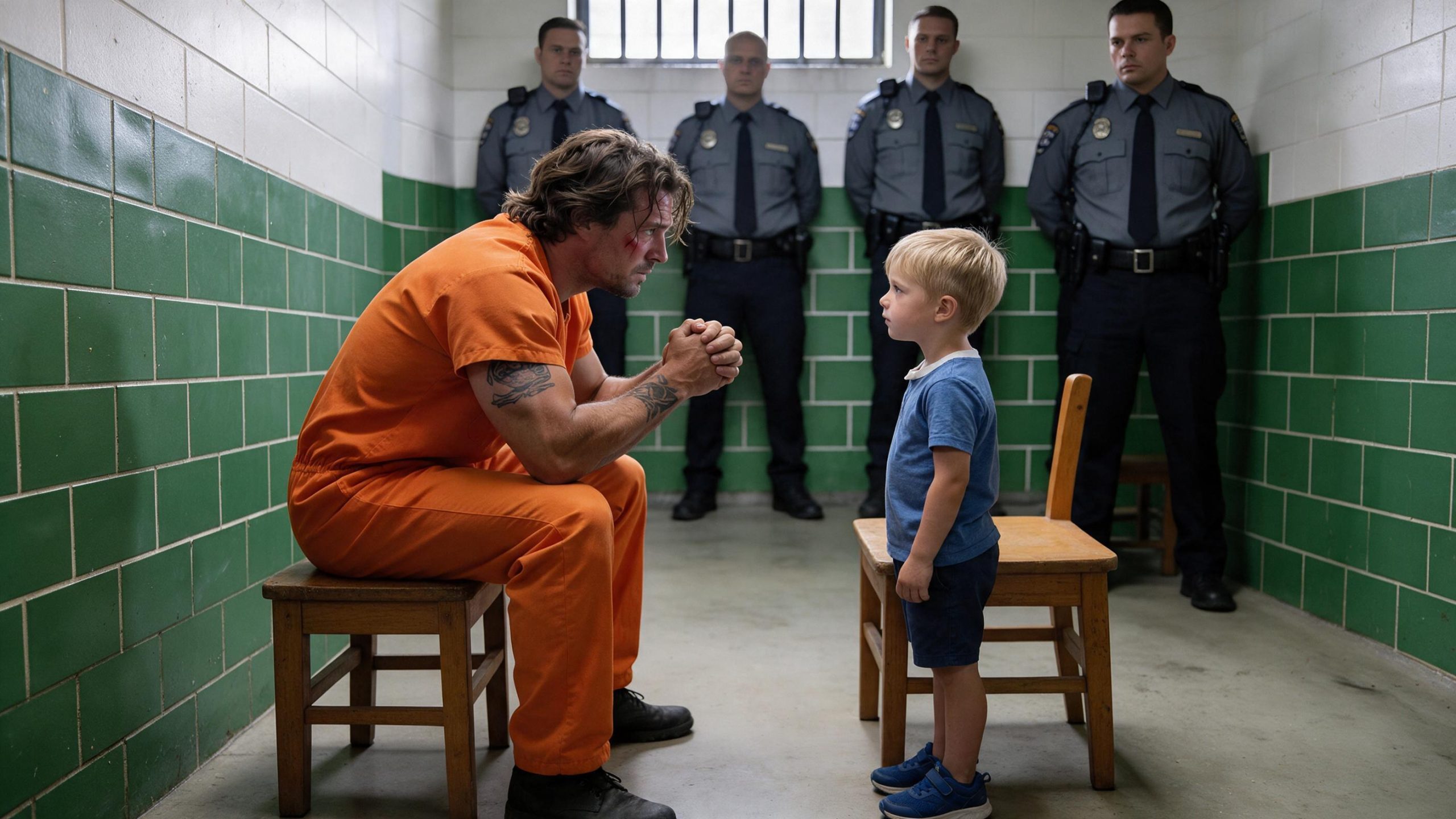
With only ninety minutes remaining before his scheduled execution, an eight-year-old boy leaned toward his father’s ear and whispered six words that froze every guard in the room.
Within the next hour, the state would be forced to suspend the execution—and a verdict everyone believed was final would begin to unravel.
That morning, with fewer than seventeen hours remaining before he was scheduled to die, Ryan Calloway asked the guards for only one thing.
Not a final meal.
Not a chaplain.
Not one last telephone call to the attorney who had already exhausted every legal avenue available.
“I want to see my son,” Ryan said quietly. “Just once. Please let me say goodbye to Liam.”
Requests like that were almost always denied so close to an execution.
But the paperwork eventually reached the office of Warden Tom Bennett, a man who had escorted more prisoners toward the death chamber than he cared to remember.
In thirty-one years working inside the prison system, Bennett had learned not to confuse emotion with innocence.
Still, something about Ryan Calloway’s case had bothered him from the beginning.
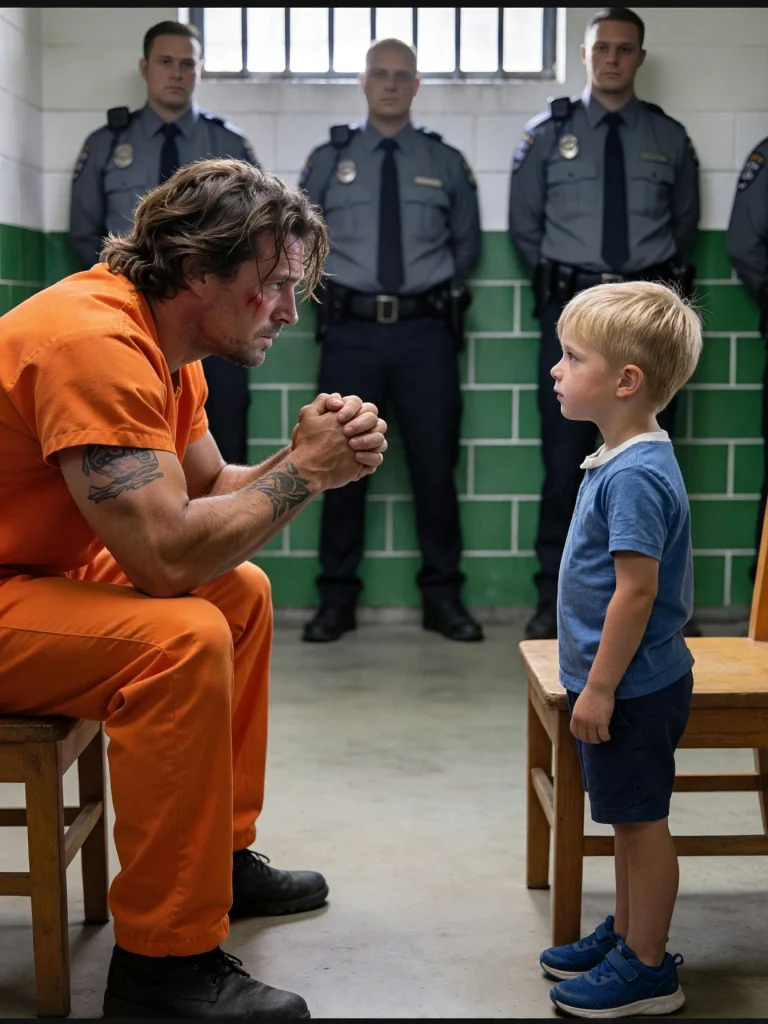
The evidence against Ryan had looked convincing.
But somehow, it had never felt completely airtight.
Bennett had watched guilty men face their final mornings before. Their eyes usually carried one of two things: fear or a hollow acceptance of what was about to happen.
Ryan’s eyes carried neither.
They carried certainty.
The stubborn certainty of a man who knew exactly what had happened but had spent five years failing to make anyone believe him.
Bennett stared at the request for a long time.
Then he picked up his pen.
He signed it.
“Bring the boy in.”
Three hours later, a white Department of Corrections vehicle passed through the main gates of Ridgeline Correctional Facility, its tires crunching across the wet gravel.
A social worker stepped out first, holding a clipboard against her chest.
Then came an eight-year-old boy in a denim jacket.
His hair was the color of wheat, his blue eyes unusually serious for a child his age.
His name was Liam.
He did not cry as he entered the prison.
He asked no questions about the razor wire, the metal detectors, or the heavy doors locking behind him one after another.
He simply walked beside the social worker, holding her hand as they passed through five security checkpoints in complete silence.
Conversations stopped as he passed.
Prisoners who rarely looked away from their own cells turned their heads.
Even guards who had witnessed nearly every form of grief imaginable suddenly found themselves looking away.
There was something unbearably difficult about seeing such a young child walking toward a final goodbye with his father.
When the visitation-room door finally opened, Ryan was already sitting inside.
His wrists were secured to a steel table bolted into the floor.
The moment he saw his son standing in the doorway, the composure he had fought so hard to maintain disappeared.
“My boy…” he whispered.
That was all he could manage.
Tears filled his eyes.
The orange prison uniform hung loosely from his body. Five years behind bars, limited food, sleepless nights, and endless grief had stripped nearly twenty pounds from him.
Inside his cell, Ryan had imagined this moment a thousand times.
He had rehearsed everything he wanted to tell Liam.
How proud he was.
How sorry he was.
How much he loved him.
But when the moment finally arrived, none of those carefully prepared words came.
Liam slowly crossed the room.
He did not run into his father’s arms.
He did not collapse into tears.
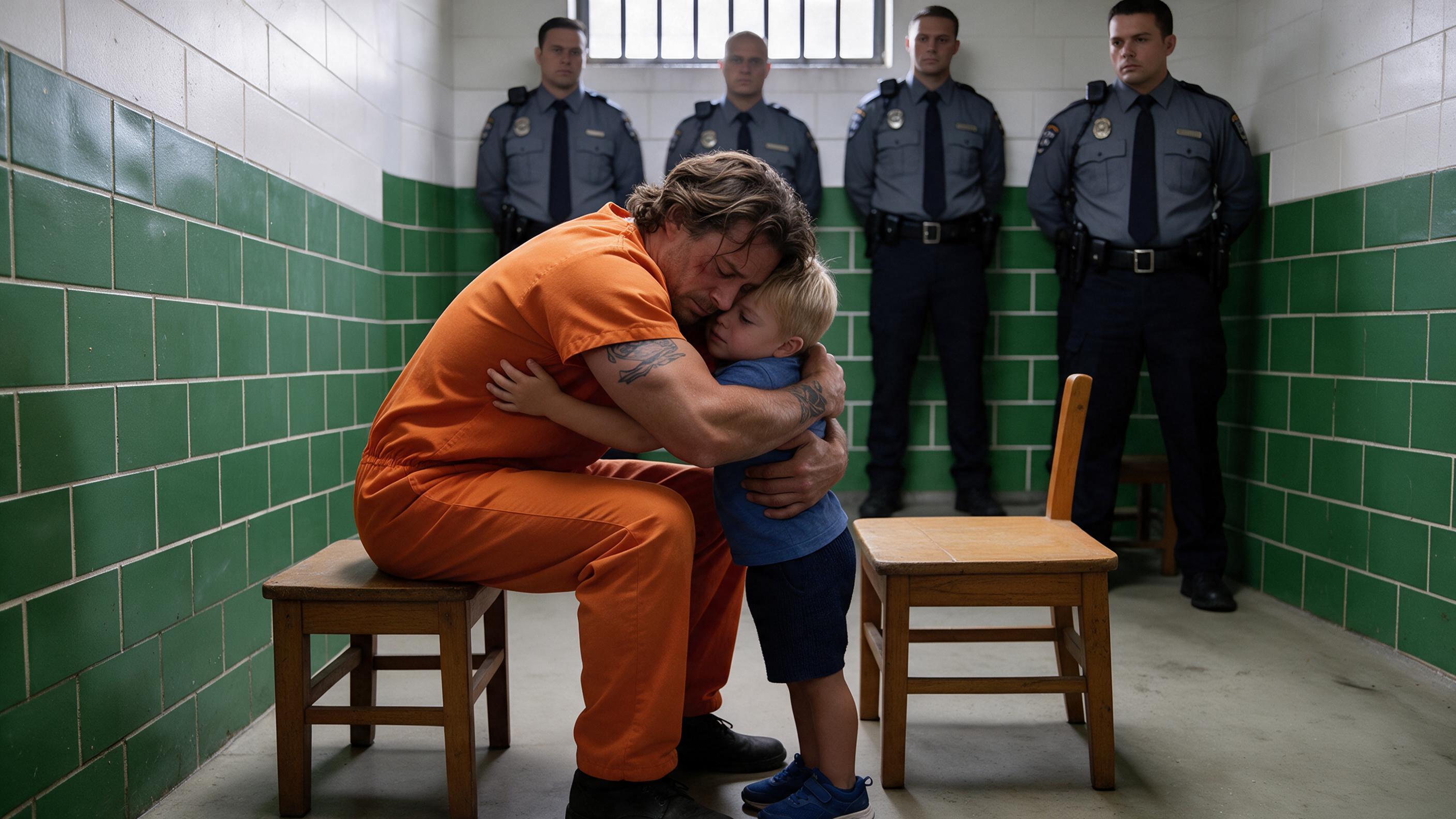
Instead, he simply stepped as close as the table allowed and wrapped his arms gently around his father’s neck.
Ryan closed his eyes.
For several long seconds, no one moved.
It felt as though the entire room had stopped breathing.
Then Liam leaned closer.
He pressed his mouth near his father’s ear.
And he whispered something so softly that no one else could hear a single word.
The senior guard instinctively moved his hand toward his belt.
Warden Bennett, standing near the doorway, felt an inexplicable chill run through him.
Ryan Calloway—who had less than two hours left to live—suddenly became completely still.
Then his entire body began trembling.
And finally, for the first time in five years…
Ryan smiled.
The senior guard looked toward Bennett, silently asking whether he should intervene.
Bennett shook his head.
He kept watching.
He had spent thirty-one years learning to read the faces of people who believed they had nothing left to lose.
And what he saw on Ryan Calloway’s face was not the expression of a father saying goodbye.
It was the expression of a man who had suddenly found a reason to fight.
CONTINUED BELOW — PART 2